


Park, Jinha
Busan International Photo Festival 2025
Honbul, Light of the Abyss
From September 24 to October 14, the Busan International Photography Festival will feature the thematic exhibition "Honbul, Light of the Abyss" at F1963 Sukcheon Hall. This groundbreaking exhibition will be the first in South Korea to delve into "human existence through Korea's unique cultural and philosophical lens, " drawing from the nation's rich spiritual traditions to offer a new perspective on how these influences shape our understanding of life. Showcasing works by both Korean and international artists, the exhibition will examine the distinct artistic and philosophical significance of Korea’s cultural and spiritual heritage. Through this exhibition, the 2025 Busan International Photography Festival presents a new, thought-provoking theme, highlighting Korean photography as both firmly based in the nation’s traditions and poised to make an impact on the global stage. Many photography festivals across South Korea, including those in Seoul, show a tendency to follow the same patterns as previous events, focusing on themes based on Western photography theories and primarily offering a platform for well-known international artists. As a result, they have struggled to rise above the limitations of being perceived as just another localized cultural event, lacking broader international impact.
The 2025 Busan International Photography Festival blends Western art theory with a distinctly Korean vision, offering a platform to showcase the unique identity of Korean photography through the theme "Honbul, Light of the Abyss." By doing so, the festival aims to elevate its position and reputation as South Korea's leading photography event.
Artistic Director : Lee Il Woo(www.facebook.com/ilwoo.lee.58)
2025 BIPF Main Exhibition
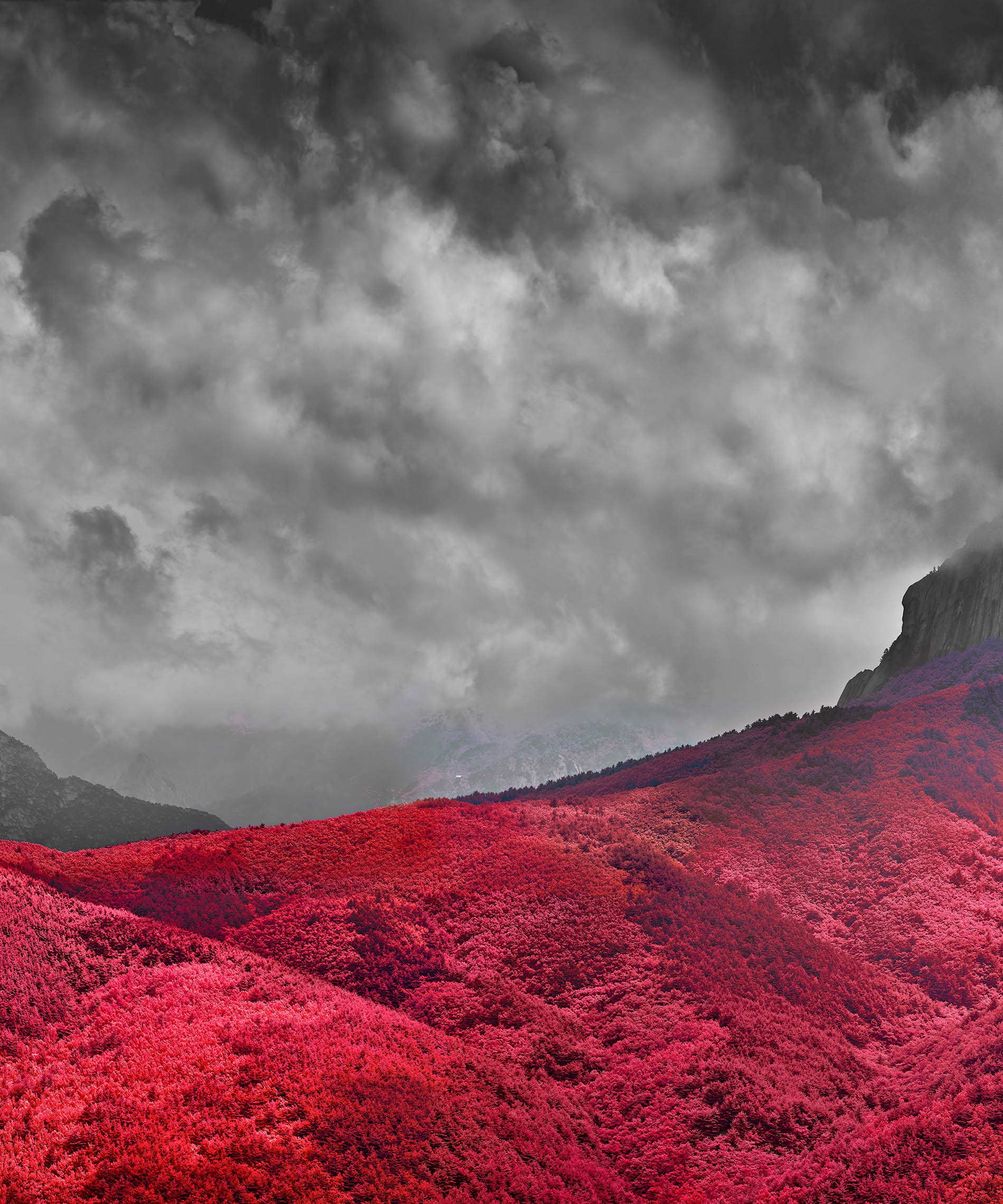
JinHa PARK presents the Seoraksan(East side of Korea, International Park)series Beyond under the theme of the "landscape beyond landscape," transcending human perception and the limitations of the photographic medium. Created through a combination of infrared photography, stitching, and stacking techniques, the monumental panoramic works reconstruct reality as a multi-layered and expanded space. In these images, from which conventional perspective has been removed, the depth of monochrome coexists with vivid reds, forming a landscape that is at once unfamiliar and striking.
Seoraksan has long been regarded as a sacred natural site imbued with the spiritual and cultural identity of the Korean people. Reimagined through the lens of infrared as a mountain glowing red, it symbolises fire, vitality, and birth. At the same time, it expands to evoke the collective energy and unity of contemporary society. By bringing into the frame realms beyond sensory perception and dimensions inaccessible to the eye, the artist invites us to experience landscape not merely as physical space but as a stratum of ‘hidden reality’. Ultimately, his photographs guide the viewer to explore what lies beyond the boundaries of perception.
Curator : Jeongeun Lee (www.instagram.com/jeongeun.artist)
38°11'36.3"N 128°28'32.8"E , Beyond (Manual of Landscape)
2021 Summer
Archival pigment print
15.000x 3.000 (1.500x 3.000x 10ea)
Infrared Stitched Stacked Panorama
38°05'02.9"N 128°25’49.7"E , Beyond (Manual of Landscape)
2022 Summer
Archival pigment print
3.000x 3.000 (1.500x 3.000x 2ea)
Infrared Stitched Stacked Panorama
Artist Statement:
The two large-scale works presented in this exhibition are part of Beyond, a long-term body of work within the artist’s ongoing Manual of Landscape series. The project integrates diverse theoretical strata — including philosophy, aesthetics, architecture, urbanism, physics, and religious thought — in order to reconstruct the relationship between nature and humanity, landscape and perception, through the artist’s own comprehensive vision. Situated at the intersection of technology and contemplation, discipline and sensibility, the series moves beyond the mere representation of landscape to propose a hypothesis concerning alternative worlds and modes of existence.
In pursuit of constructing images with a profound sense of plausibility, the artist synthesises the capabilities of contemporary technical camera systems and optical methodologies, revealing dimensions of actual landscapes that lie beyond the ordinary limits of human perception. Through this process, photography ceases to function merely as an instrument of documentation and instead becomes a medium through which the boundaries of perception itself may be expanded.
The artist explores what may be described as a “landscape beyond landscape” — a realm that exceeds both human sensory experience and the conventional limits of the photographic medium. This approach metaphorically reflects the concepts of the multiverse and “hidden reality” proposed by the physicist Brian Greene, suggesting that photography may operate not only as a representational device, but also as a medium of cognition and generation. The work seeks to incorporate within the photographic frame dimensions beyond sensory reach, spaces beyond the visible gaze, and temporalities whose existence itself remains uncertain. Here, landscape no longer resides solely as physical space; rather, it emerges as a multilayered reality in which sensation, memory, time, and experience coexist and overlap.
Such an approach constitutes a photographic inquiry that moves beyond the traditional notion of the “decisive moment”. Rather than isolating a singular instant, the works reveal fluctuating and interwoven layers of space and time, suggesting the possibility of an indeterminate reality. Techniques such as long exposure, layering, the intervention of memory, and the accumulation of sensory traces do not merely record a scene, but instead compress temporal duration and interior experience into the image itself. Consequently, photography functions not as a static reproduction of the world, but as a structure of thought capable of generating complexity and latent realities.
Within Beyond, transcendence operates not simply as a conceptual theme, but as a performative mode of thought. In this respect, the work resonates with the Theory of Forms proposed by Plato, with the Christian mystical notion of “invisible reality”, and with the metaphysical traditions of Neoplatonism and Buddhist enlightenment. Through the visible medium of photography, the artist metaphorically gestures towards an absolute reality existing beyond the horizon of sensory perception. Rather than remaining within the confines of recording the visible world, the work seeks to retain traces of the imperceptible, the unexplainable, and the unseen within the photographic image.
Ultimately, Beyond, within the broader Manual of Landscape series, expands the established boundaries of the photographic medium and moves beyond image-making centred solely upon representation. The work invites viewers to reconsider landscape not merely as an object, but as a site where perception, existence, time, and memory intersect. In doing so, it fundamentally questions the ways in which reality itself is understood. Furthermore, the six previously distinct thematic strands within the artist’s practice are no longer treated as separate entities, but coexist within a unified structure of thought that permeates the series as a whole. The artist is currently developing a new chapter that extends beyond these seven thematic trajectories, further expanding the conceptual and philosophical scope of the work.
- JinHa Park




Überlandstrasse 241
8600 Dübendorf
瑞士
Phone: +41 44 383 92 22
@2026 all rights reserved

PRECISION MEASURED IN MICRONS. PASSION MEASURED IN DECADES